Terry Gross
| Total Responses: | 3 |
| Average Quality Score: | 67.7 |
| Average Bias Score: | 2.0 |
| gen: 2026/09/24:02:24 in 33.9 sec (old)bias: 1 (Center) |
| type: newsquality: 55 |
| pts: 0 |

#diplomacy#china#taiwan#cybersecurity#ai#donald trump#xi jinping#rush doshi#terry gross#united states po
 | author: | Terry Gross | institution: | NPR | ¿porque no los dos? |
| tl;dr | The page introduces a Fresh Air interview hosted by Terry Gross with Rush Doshi of the Council on Foreign Relations about U.S.–China relations ahead of a planned Trump–Xi summit. The headline highlights cybersecurity, artificial intelligence, and Taiwan. Only a brief introduction and a 43-minute audio player are visible; the interview’s arguments, evidence, and predictions cannot be assessed from these images. | ||||
| deeper: | The visible headline and introduction use neutral language without praising or attacking either leader or promoting a political position. The guest and his affiliation are clearly identified. However, the page provides no transcript, supporting evidence, or substantive policy explanation. These scores apply only to the visible introduction, not the unavailable audio; the screenshot alone also cannot establish authenticity or verify the summit details. | ||||
media: | |||||
| gen: 2026/09/12:23:36 in 35.3 sec (old)bias: 1 (Center) |
| type: lolsquality: 70 |
| pts: 0 |

#remembrance#september 11#firefighters#poetry#music#world trade ctr#new york city#fdny#jay jonas#josephine harris
 | author: | Terry Gross | institution: | NPR | ¿porque no los dos? |
| tl;dr | This Fresh Air retrospective commemorates September 11 through archived interviews about survival, rescue, grief and artistic responses. Firefighter Jay Jonas recounts surviving the North Tower’s collapse while helping Josephine Harris; Ken Haskell describes losing his two brothers; and Dennis Smith discusses firefighting challenges. Poets Sekou Sundiata and Robert Pinsky explore mourning, while Sonny Rollins recalls evacuation and performing afterward. The page presents itself as a 25th-anniversary broadcast in 2026, but contains factual and chronological problems. | ||||
| deeper: | The piece emphasizes compassion, public service and remembrance without a clear partisan agenda. Its sympathetic questions and heroic language fit a commemorative interview format. Named eyewitnesses, dated archival excerpts and detailed testimony are strengths. However, technical claims about the towers collapsing as designed or through a simple pancake mechanism need correction or expert context. Jonas is mistakenly identified as NYPD rather than FDNY. Dennis Smith’s death is described as occurring 'in January,' although he died in January 2022, creating a misleading timeline within the 2026 framing. | ||||
media: | |||||
| gen: 2026/08/12:19:27 in 49.4 sec (old)bias: 4 (Center-Left) |
| type: newsquality: 78 |
| pts: 0 |
 | author: | Terry Gross | institution: | WHYY / NPR | ¿porque no los dos? |
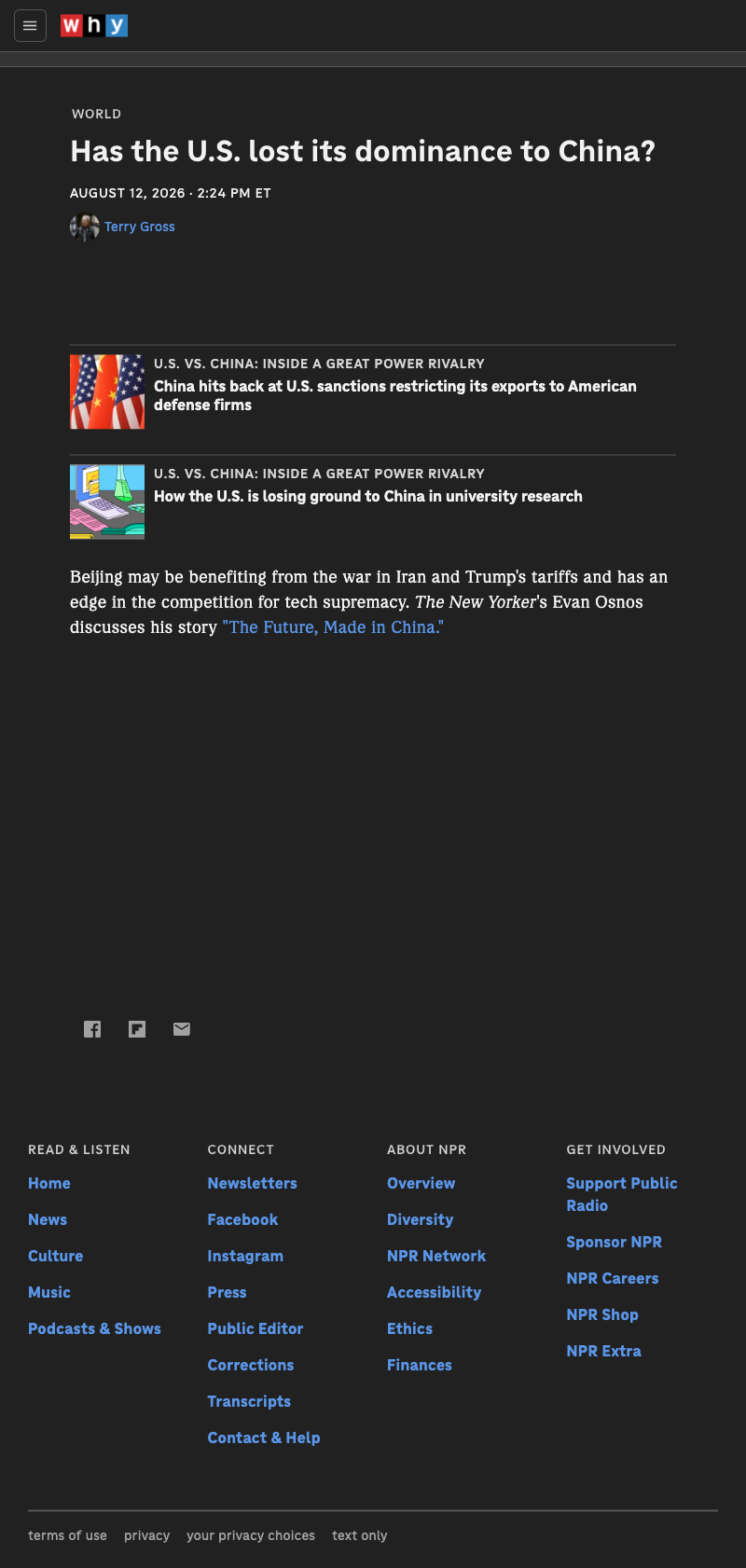
| tl;dr | A WHYY/NPR World segment titled “Has the U.S. lost its dominance to China?” (Aug. 12, 2026) frames U.S.–China relations as a great-power rivalry focused on technology, research, sanctions, and trade. The page highlights related items about China retaliating against U.S. sanctions and the U.S. losing ground in university research. The teaser says Beijing may be benefiting from the war in Iran and Trump-era tariffs, and features discussion with The New Yorker’s Evan Osnos about “The Future, Made in China.” | ||||
| deeper: | The framing (“lost its dominance,” “great power rivalry,” “losing ground”) emphasizes competition and U.S. relative decline, which can steer interpretation before evidence is presented. The teaser also asserts causal benefits to Beijing (Iran war, tariffs) without showing data in the screenshot, suggesting some agenda-setting via selection and tone. Still, it appears to be an interview-based explainer referencing a named journalist and specific reported work, which generally supports credibility; what’s missing here are visible primary sources, quantified measures of “dominance,” and explicit countervailing views in the excerpt shown. | ||||
media: | |||||
You made it to the bottom. Now dance!


owned and operated by: RPN Omnigalactic Insitutution as of: 2026/10/15: 15:18 in 0 ms
Enter Code
Login with Account